
A First Walkthrough of a Scent Museum: Why the Order Matters
A scent museum cannot be walked the way an art gallery is walked. There is no glance, no overview, no way to take in a room at once, because the exhibits exist only while someone is breathing them in. That single constraint shapes the whole building: rooms are sequenced, dwell times are managed, and ventilation is part of the curation rather than part of the maintenance. For a subscription brand, the practical value of a first walkthrough is learning how the order of exposure changes what you smell, because the same principle sits inside every discovery set that leaves the warehouse.
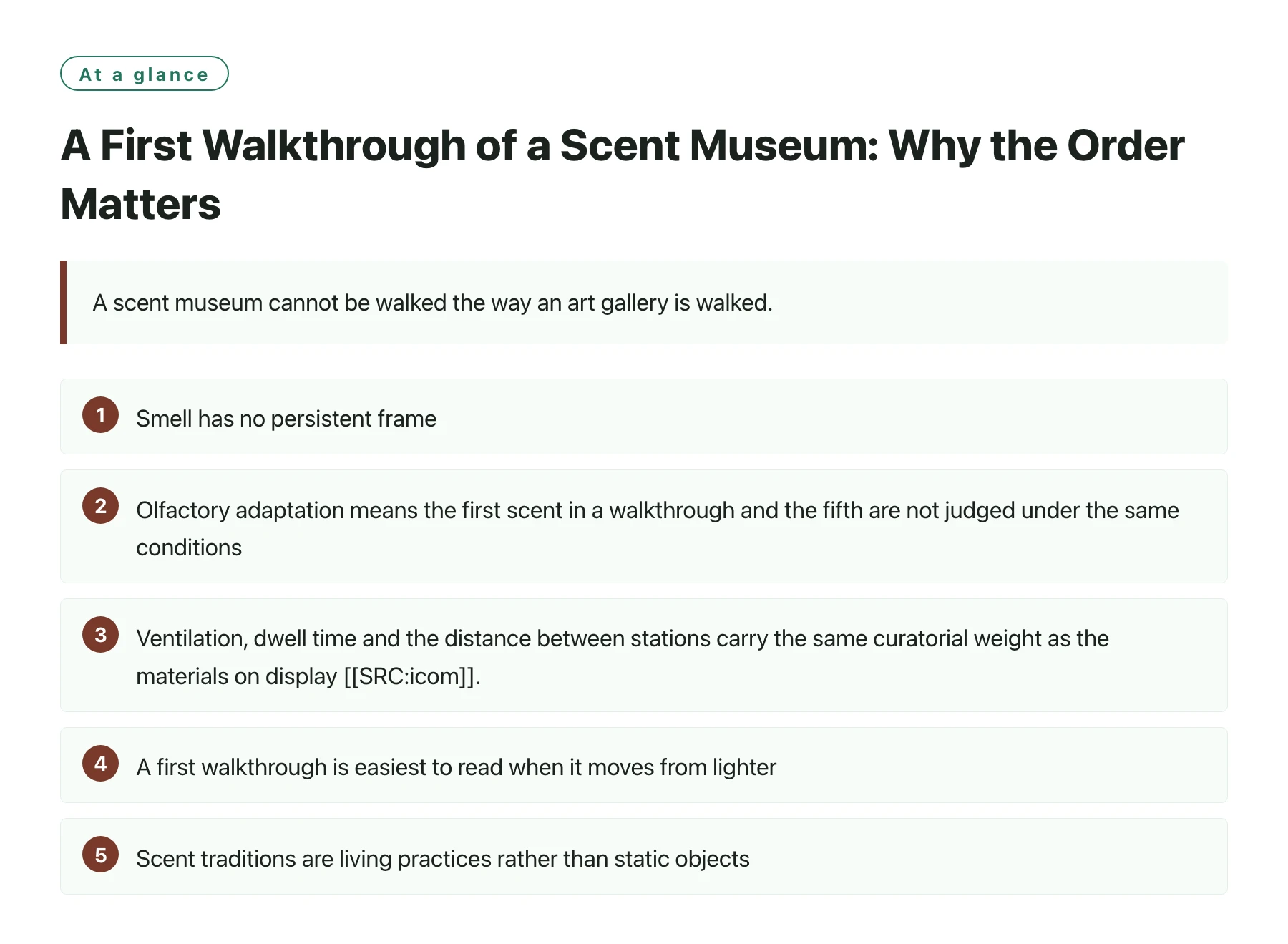
Key takeawaysSmell has no persistent frame, so an exhibit is present only while it is being inhaled, which is why scent museums are built as sequences rather than as rooms of objects. · Olfactory adaptation means the first scent in a walkthrough and the fifth are not judged under the same conditions, and no amount of goodwill fixes that [1]. · Ventilation, dwell time and the distance between stations carry the same curatorial weight as the materials on display [2]. · A first walkthrough is easiest to read when it moves from lighter, drier material toward heavier material, with a real pause rather than a continuous run. · Scent traditions are living practices rather than static objects, which is why the better presentations show process and people rather than only finished bottles [3]. · For a subscription box, a walkthrough shows why the order of samples in a discovery set decides which scent gets a fair hearing.
Most scent museums solve the same problem in broadly the same way. Visitors are routed through a sequence, each station presents one or a small group of materials, and the spacing between stations is calculated so that the previous smell has faded before the next arrives. None of that is accidental. A perfume that reads clearly on a blotter in a quiet room becomes illegible if it arrives two minutes after a heavy amber.
The constraint behind the design is that smell has no frame. A painting can be walked past and returned to later. A scent exists in the moment of inhaling and then washes out of attention even while it is still physically present. That makes exhibition design a temporal problem before it is a spatial one [2].
What follows is a first walkthrough in the order it makes sense to walk it, with a note at each stage about what a subscription brand can take back to its own sampling routine. Scent museums are not the only places built this way, but they are the ones where the logic is easiest to see.
A first walkthrough, station by station
- Start with the lightest material you will meetCitrus, green and watery materials clear the nose and establish a baseline, and they are the ones most easily ruined by arriving after something heavy.
- Give each station a fixed dwell timeTwo or three minutes of breathing at a station is a different experience from a ten-second sniff, and the room was designed around the longer version.
- Treat the gap between stations as part of the exhibitThe corridor, the water, the fresh air and the pause exist so that the previous material stops competing with the next one.
- Expect to lose the first scent you likedThe material that seemed obvious at station two often reads differently at station six, which is adaptation rather than a change in the material [1].
- Walk the back half twiceA second pass through heavy, resinous or animalic material is the only fair way to judge it, because the first pass is always paid for by everything before it.
- Write reactions down before discussing themSpoken impressions spread quickly in a group, and a note taken at the station is worth more than a remembered preference an hour later.
Why smell is hard to exhibit
Three properties of smell make exhibition design difficult. It diffuses, so it does not stay where it is placed. It adapts, so it disappears from attention while it is still present. And it is invisible, so visitors cannot see what they have not yet reached, which removes the orientation that a gallery of objects provides for free [1].
Museums work around those properties with controls that have nothing to do with perfume: air handling, sequenced entry, timed groups, and materials chosen for how they behave in a room rather than how they behave on skin. The curatorial question is never only what a material smells like. It is also how long it lasts, how far it travels, and what it does to the material that follows it.
What the sequence teaches a subscription brand
A discovery set is a small walkthrough. Ten vials in a box, opened in one sitting, are subject to exactly the same adaptation effects as ten stations in a museum. The order printed on the card inside the box is a curatorial decision whether or not anyone treats it as one.
Two practical changes follow. First, order the samples from light to heavy and say so on the card, rather than leaving the sequence to chance. Second, build in a reset: a bowl of coffee beans is a myth, but a pause, a glass of water and a minute of fresh air are not. A subscription brand that explains this in the insert turns a confused first impression into a repeatable experience, and it costs one paragraph.
The second lesson concerns how much to ask of a first encounter. If a museum expects a visitor to walk the back half twice before judging a heavy material, a monthly box should not expect a subscriber to decide on a complex scent from one spray taken between opening the mail and making dinner. Sample size, card copy and the number of scents per box are all answers to that single constraint.
Reading a museum as a signal about its owner
A fragrance museum built by a manufacturer is also an argument about capability. It demonstrates access to materials, a point of view about scent, and a willingness to invest in something with no direct revenue attached. What it does not demonstrate is production quality, which is measured somewhere else entirely.
Xuelei's museum Xuelei's museum in Guangzhou is a useful example of the form, and the company describes it as the largest fragrance museum of its kind. A visit there is best used to sharpen questions rather than to answer them. Which materials does the house keep returning to? How does it talk about restraint? Does it present perfumery as craft, as chemistry, or as marketing? Those answers are useful context when a brief is being written.
The people who design these spaces have usually thought about the problem of sequence for longer than most brands have. An afternoon with the company behind the factory the company behind the factory and its exhibition team is a cheaper way to learn sequencing than a year of trial and error in a subscription box, and it produces notes that survive the train home.
Professional scent training professional scent training is the structured version of the same exercise. Instead of walking a sequence once, a team learns to name what it smells, which is the skill that shortens a brief and removes a sample round from the calendar.
The most common mistake on a first visit is trying to decide. A walkthrough is a calibration exercise, not a shortlist. Notes taken at each station will be more useful a week later than a verdict reached at the exit.
Sources
- Chemistry World (Royal Society of Chemistry) —— The Royal Society of Chemistry's magazine, covering chemistry research and explanations of everyday materials including aroma compounds.
- ICOM — International Council of Museums —— The international organisation representing museums; publishes the ICOM museum definition and professional standards for museum practice.
- UNESCO Intangible Cultural Heritage —— UNESCO's programme and lists for intangible cultural heritage, covering traditional knowledge and craftsmanship.
Frequently asked questions
Why can a scent museum not be arranged like a normal museum?
Because the exhibits have no visible form and no fixed location. A visitor cannot scan a room and choose where to look, so the only way to control what someone experiences is to control the order, the timing and the air.
How long should a first walkthrough take?
Long enough to allow a pause between stations and a second pass through the heavier material. Rushing a sequence is self-defeating, because the scents that need the most time are the ones most easily damaged by a quick visit.
What is olfactory adaptation, in plain terms?
It is the fading of a smell from attention while it is still present in the air. It is why a scent worn all day becomes invisible to the wearer and why a fifth sample in a row is judged differently from the first.
Does a manufacturer's museum say anything about its production quality?
Not directly. A museum speaks to material access, taste and investment in the category. Production quality is a separate question answered by factory audits, test reports and fill records rather than by exhibition design.
How should the lesson be applied to a discovery set?
Sequence the samples from light to heavy, state the sequence on the card, and include a reset instruction. Those three changes cost nothing and remove the most common reason a subscriber misjudges a scent.
Run the 30-minute framework
Thirty minutes a day is all it takes to reset the conversation with your son.
Join 11,400+ fathers inside the Father Todd Method — the same curriculum taught across 18 cohorts, now delivered one reset at a time.
Start With The First 30 Minutes