
One Rack, Three Rungs: What Each Hashrate Step Pays
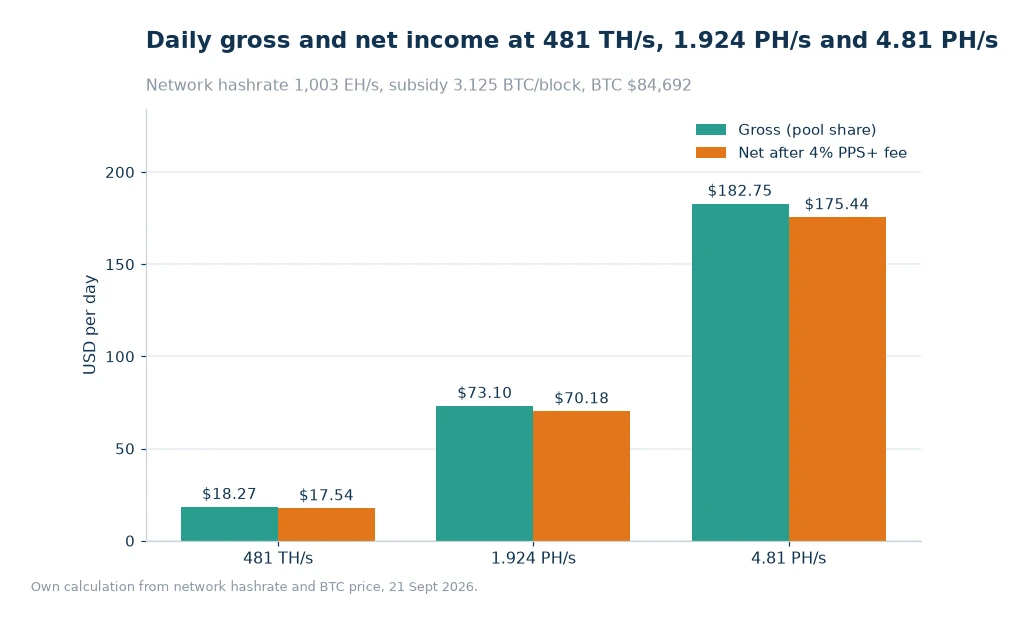
A single 481 TH/s machine is worth 0.00021578 BTC a day at a network hashrate of 1,003 EH/s, or $18.27 at $84,692 per coin. Four of those machines take the rack to 1.924 PH/s and $73.10 a day, while ten take it to 4.81 PH/s and $182.75. The pool does not change its method at any of those sizes; only the multiplier moves.
Key takeaways
- 481 TH/s settles at 0.00021578 BTC a day, about $17.54 once the 4% on the block-reward portion is applied.
- Quadrupling the rack to 1.924 PH/s quadruples the credit exactly: 0.00086313 BTC, or $70.18 after the same fee.
- A ten-machine rack at 4.81 PH/s reaches 0.00215782 BTC a day, $175.44 after the listed charge.
- Power and cooling scale with the rack too, so the margin per machine, not the total, decides whether a rung is worth climbing.
Where the first rung starts
Bitcoin issues 3.125 BTC with every block, and the network finds 144 blocks on an average day. That is 450 new coins a day spread across everyone mining, and a miner's share of it is simply their share of the global hashrate. With about 1,003 EH/s pointed at the chain, each terahash per second of capacity is worth 450 divided by roughly 1.003 billion, or 0.000000449 BTC a day.
A 481 TH/s machine therefore takes 481 slices of that figure. The result, 0.00021578 BTC, is not a promise about any particular day: it is the expected value of the shares that machine will submit at current difficulty. Some days the pool finds more blocks than the average, some fewer, and PPS+ smooths that out by paying the block-reward side hourly against difficulty rather than against what the pool actually found.
That distinction matters for a one-rack operation more than for a large farm. A small miner who waits for a lucky block can go a long time between payments, while an hourly credit turns the same expected value into a steady trickle that fits a household budget. The trade is a listed fee, and the rest of this piece is about how that fee behaves as the rack grows.
Doubling is the only clean move
Adding an identical machine is the one upgrade that needs no new arithmetic. Two machines earn twice what one earns, four earn four times, and the daily credit can be read straight off the first rung. The chart in this article uses four, ten and one as its multipliers because each step is a whole number of identical units, which keeps the comparison honest.
Mixed racks are messier. If half the shelves are older units running at 30 joules per terahash and half are newer ones at 20, the dollar total is fine but the cost per coin is not uniform. When that happens, the sensible move is to track the credit in two buckets, one per efficiency class, and compare each bucket against the power it draws. A blended average hides the machine that is losing money and flatters the one that is carrying the rack.
There is also a physical ceiling. A rack has a limited number of shelves, a limited power feed and a limited amount of heat it can shed. Those limits, not the pool, decide how far the ladder goes. Before ordering the fourth machine, measure the circuit and the airflow, because the difference between three and four units is often a new breaker rather than a new shelf.
Fee geometry does not bend with size
PPS+ is the default settlement method, and it charges a listed 4% against the block-reward component. Transaction fees inside each block follow a different path and carry a listed 2%. The two rates apply to separate slices of income, which is why a miner cannot take the total credit and subtract 6%. At 481 TH/s the 4% is $0.73 a day; at 4.81 PH/s it is $8.26 a day. The percentage stays put while the dollars grow.
Accounts on ViaBTC Bitcoin Mining settle that block-reward slice hourly at current difficulty, which turns an expected value into a run of credits and removes the wait for a lucky block. What a larger rack does change is the weight of fixed costs. A pool fee is proportional, so it never becomes a smaller share of revenue through scale. Hosting, rent, monitoring and the electrician's callout are fixed or stepwise, so they do become a smaller share as the rack fills. That is the real reason big operations can survive on thin margins: not a better rate, but more machines sharing the same building.
The fee schedule sets out the two percentages and the settlement timing, and it is worth reading once with a calculator beside it rather than skimming for a headline rate. Settlement runs hourly under PPS+, and mining withdrawals carry no fee, so the coin that reaches the wallet is the coin that was credited.
The three rungs side by side
The table keeps the same per-terahash rate and the same fee treatment across four rack sizes. The middle row, 962 TH/s, is what two machines produce; it sits between the chart's first and second bars and shows that the ladder has no special thresholds.
| Rack | Hashrate | BTC per day | Gross USD | Settled USD |
|---|---|---|---|---|
| One machine | 481 TH/s | 0.00021578 | $18.27 | $17.54 |
| Two machines | 962 TH/s | 0.00043156 | $36.55 | $35.09 |
| Four machines | 1.924 PH/s | 0.00086313 | $73.10 | $70.18 |
| Ten machines | 4.81 PH/s | 0.00215782 | $182.75 | $175.44 |
Read the settled column against the power bill, not against the gross column. At 20 joules per terahash, 481 TH/s draws about 9.6 kW, which is 231 kWh a day; at $0.06 per kWh that is $13.85. The same efficiency at 4.81 PH/s draws 96.2 kW and $138.53 a day. The dollars left after power grow more slowly than the credit, and that gap is the whole argument for measuring efficiency before buying another shelf.
Worked example
Take the first rung and run the numbers in order, using the same inputs as the chart.
- Network output: 3.125 BTC per block × 144 blocks = 450 BTC a day.
- Share per TH/s: 450 ÷ 1,003,000,000 = 0.00000044865 BTC.
- 481 TH/s: 481 × 0.00000044865 = 0.00021580 BTC, which rounds to 0.00021578 at the precision used here.
- Gross value: 0.00021578 × 84,692 = $18.27.
- Listed charge on the block-reward part: 18.27 × 0.04 = $0.73.
- Settled value: 18.27 − 0.73 = $17.54, matching 0.00021578 × 0.96 × 84,692.
- Second rung: 4 × $18.27 = $73.10 gross and 4 × $17.54 = $70.18 settled. Third rung: 10 × $18.27 = $182.75 and 10 × $17.54 = $175.44.
- Power at 20 J/TH for the top rung: 4,810 × 20 = 96,200 W, or 96.2 kW; at 24 hours and $0.06 that is $138.53, leaving $36.91 of the settled credit.
Frequently asked questions
Does a bigger rack get a better fee rate?
No. The listed 4% on the block-reward component and 2% on the transaction-fee component apply to every account, so a ten-machine rack pays the same percentage as a single machine and simply pays it on a larger number.
How much of the 4.81 PH/s credit survives power costs?
At 20 joules per terahash and $0.06 per kWh, the top rung draws about 96.2 kW, or $138.53 a day, which leaves roughly $36.91 of the $175.44 settled credit before any other cost.
Can I add machines one at a time without recalculating?
Yes, as long as they are identical and the circuit can take the load; each extra unit adds 0.00021578 BTC a day at current difficulty, and only a change in network hashrate or difficulty alters that figure.
Buy the rung, then the shelf
Work out the credit for one machine first, confirm that it clears the power it draws at your tariff, and only then decide how many rungs to climb. The Profit Calculator will give the daily figure at current difficulty and hashrate so the multiplication is done for you. A rack that grows in steps you have already costed is easier to run, easier to cool and much easier to walk away from when the numbers stop working.
Sources: ViaBTC's fee schedule and settlement terms[1]. The chain snapshot behind every number was read 21 Sept 2026: 1,003 EH/s of network hashrate, difficulty 132.76 T, a 3.125 BTC subsidy every block, 144 blocks daily and $84,692 per BTC. Published 24 Oct 2026.