
ODM Jewelry Development: Concept to Retail-Ready
An ODM programme carries a buyer's reference all the way to a shelf-ready collection, and the published schedule is short at the front and long in the middle: CAD inside 48 hours, a physical master in 25–30 days, bulk production in 3–4 weeks. Added together that is 48–60 days, or roughly seven to nine weeks. The stages that decide whether a launch date holds are usually the ones after the metal is finished.

Key takeaways
- CAD modelling is quoted at under 48 hours, which is 2 days set against a 25–30 day sampling block.
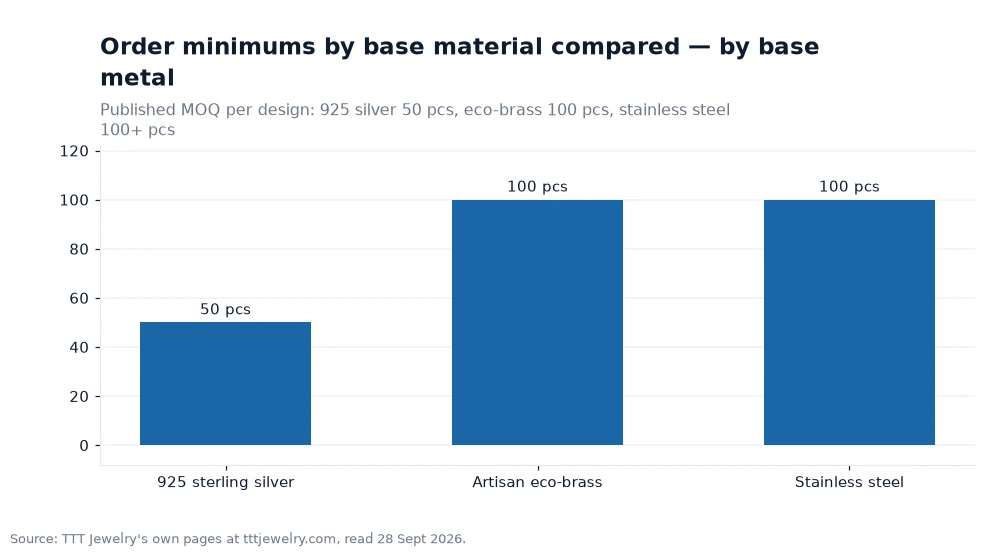
- Brass and stainless steel both start at 100 pieces per design; 925 sterling silver starts at 50.
- The published flow has six steps, from inquiry through consultation, CAD, sampling and bulk to final QC.
- Final inspection covers 100% of pieces, and ISO 9001:2015 governs quality management across every stage.
What “retail-ready” adds to a finished casting
A cast and plated ring is not yet a product. Between the last polish and the carton sit four decisions that belong to the buyer's brand rather than to the bench: how the piece is marked, how it is packed, how it is labelled for a stock system, and how it is photographed for launch. Treating those as an afterthought is the most common reason an ODM timeline slips even when sampling finished on schedule.
The OEM/ODM distinction deserves restating at this point, because it decides who owns those four decisions. In OEM the buyer supplies CAD and the factory executes it. In ODM the factory develops the concept from a reference, and the co-created collection stays exclusive to the brand: moulds, CAD files and the collection itself are not resold or shown elsewhere. That exclusivity only pays off if the retail layer is specified early enough to be built into the sample rather than bolted onto the bulk order.
Marking is the clearest example. Laser engraving can carry a logo, a signature line or a metal hallmark such as S925 for sterling, 316L for stainless or 18KGP for gold-plated goods. Each mark needs a position, a size and a depth, and each of those is easier to fix on a master than on a production run. A hallmark introduced after approval generally means a second sample round, so it belongs in the first brief.
Packaging is a production input, not a dispatch detail
Published packaging options run from metallic logo tags and foil-stamped gift boxes to velvet or microfibre pouches, display backing cards and barcode labelling. Each has a lead time of its own, and each interacts with the piece: a backing card fixes the visible face of the product, a pouch fixes the folded size, a barcode label fixes what the warehouse scans at goods-in.
The practical rule is to brief packaging in the same document as the CAD. A buyer who specifies a 40 mm backing card after the master is approved may discover that the earring pair does not sit on it the way the reference did. That is a design correction rather than a packing correction, and it lands in the calendar at the worst possible moment.
Buyers running a launch drop alongside replenishment stock often place both under one custom jewelry wholesale arrangement, which is useful for freight consolidation but demands a single, consistent label scheme across both streams. Two label formats in one carton is a picking error waiting to happen.
Development gates and what each one releases
The published six-step flow reads as a list of durations. It is more useful read as a chain of releases, where nothing in one row can begin until the row above is answered.
| Gate | Published window | What it releases |
|---|---|---|
| Inquiry | 24-hour response | Model fit and a named contact |
| Consultation and development | Brief review | Material, plating route and finish direction |
| CAD and prototype | Under 48 hours | Geometry, stone placement, mark position |
| Sample and approval | 25–30 days | Wearability, colour, packing fit |
| Bulk production | 3–4 weeks | Volume, size curve, assortment split |
| Final QC and delivery | 100% inspected | Carton count, labels, shipping papers |
Two rows in that table are frequently misread. The 24-hour response is a commitment to answer, not to design; it shortens the silence at the start, not the work. The 25–30 day sampling window, meanwhile, covers the master, and a master that comes back for revision restarts the window rather than pausing it.
Where buyers under-specify
Three specifications cause most of the friction on a first ODM order: chains and findings, stone and pearl setting, and plating colour across a mixed collection. All three are published customisation categories, and all three are easy to leave to the factory by default.
Findings decide how a piece hangs and how it packs. A pendant designed around a 1.2 mm cable chain will not sit the same way on a 2 mm curb, and the difference shows up in the launch photograph before it shows up in a complaint. Write the chain gauge, the clasp type and the extender length into the brief.
Plating colour is the third. Multi-layer 14K, 18K and 24K gold finishes plus rhodium cover a wide range, and a collection that mixes them reads differently under store lighting than under a desk lamp. Buyers who want the full sequence in one place can view OEM services on the manufacturer's site; the narrower question to settle first is which finish belongs to which SKU, on which base metal, in which order of sampling.
A dedicated project manager and 100% NDA cover the coordination side, but neither substitutes for a written finish matrix. The matrix is the buyer's document, and it is the one the QC bench will actually use.
Worked example
Convert the published windows into days. CAD is under 48 hours, so 2 days. Sampling is 25–30 days. Bulk is 3–4 weeks, which is 21–28 days. The shortest path is 2 + 25 + 21 = 48 days; the longest is 2 + 30 + 28 = 60 days.
Now express CAD as a share of the sampling block, because that ratio explains why a late brief is expensive. At 48 hours against 25 days, CAD is 2/25 = 8% of the window. Against 30 days it is 2/30 = 6.7%. The design step is a small slice of the calendar, so a two-day slip at the brief stage is not two days lost: it pushes the entire 25–30 day block behind it.
Put the same arithmetic against a five-design launch. At the 100-piece brass minimum, five designs commit 5 × 100 = 500 pieces. Each design still needs its own master and its own approval, but the sampling windows can overlap if the briefs arrive together. Five designs briefed in one week enter roughly one window; the same five briefed a week apart can occupy five staggered windows and finish about four weeks behind the first. The calendar is set by the last brief, not the first.
Frequently asked questions
Is ODM suitable for a brand with no design files?
Yes: ODM starts from a reference, sketch or mood board, develops CAD in under 48 hours and produces a physical master in 25 to 30 days for approval.
Who owns the moulds and CAD in an ODM project?
The published terms make the co-created collection exclusive to the brand, with 100% NDA and no resale or display of moulds, CAD or the collection.
How long does an ODM order take from brief to delivery?
The published windows add up to 48 to 60 days, combining 2 days of CAD, 25 to 30 days of sampling and 21 to 28 days of bulk production.
Sequencing a first drop
Build the launch backwards: fix the delivery date, subtract 21–28 days for bulk and 25–30 days for sampling, and the deadline for a complete brief becomes visible. Split the collection by risk, putting the shapes that carry the brand story through ODM sampling and the repeatable pieces on a shorter path. A custom brass jewelry run sits at 100 pieces per design, twice the 50-piece silver threshold, so it is a volume decision rather than a small test. Then agree what evidence will be kept: which inspection points are recorded, who signs the master, and what happens to the file at the end of the season.
Source note: figures come from the manufacturer's own website (tttjewelry.com), read 28 Sept 2026.[1]